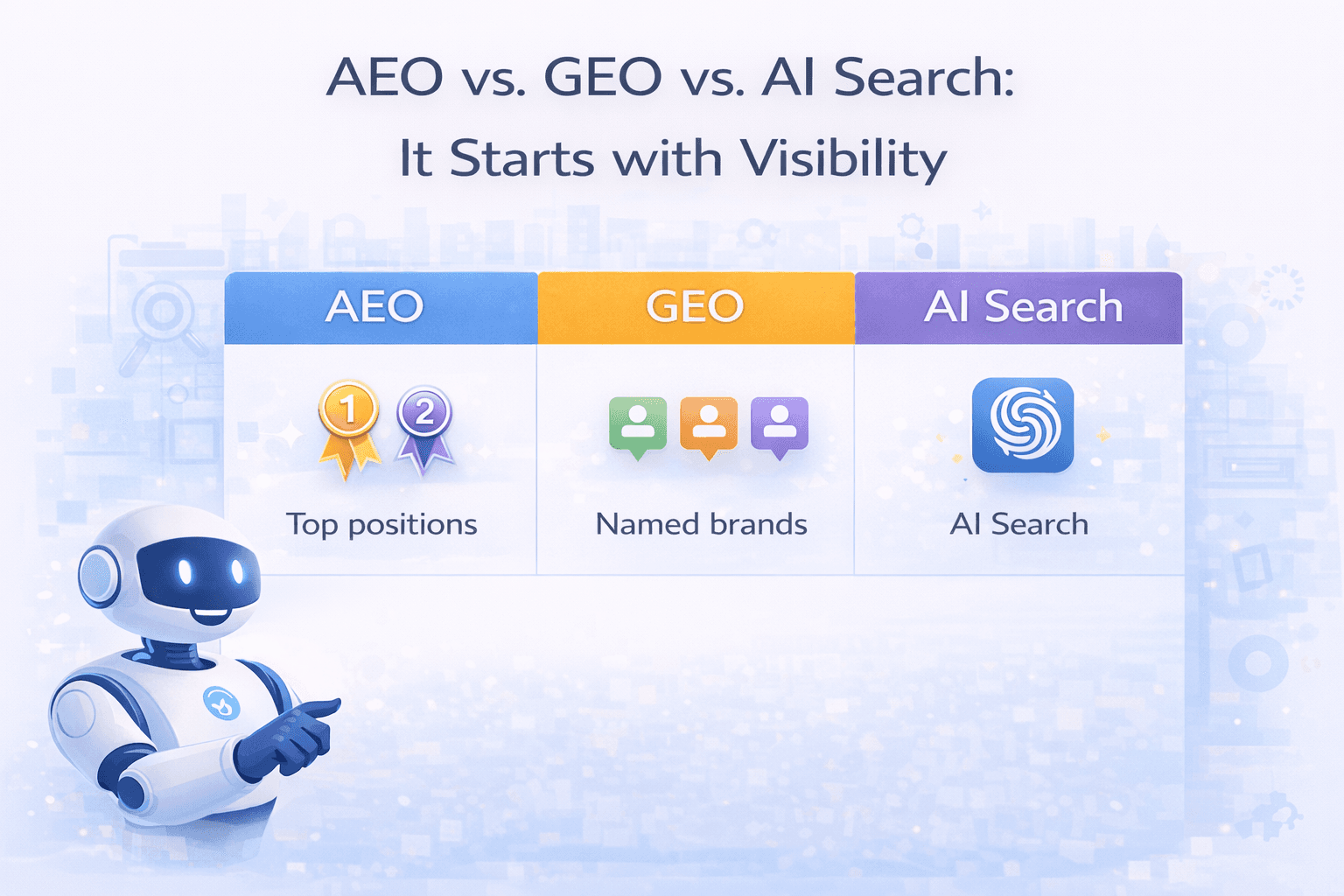
The debate over whether to call this discipline AEO, GEO, or AI Search Optimization misses the more urgent issue: most brands still do not know whether they appear in AI-generated answers at all.
The marketing industry has spent considerable energy debating what to call the practice of optimizing for AI-generated answers: AEO, GEO, AI Search Optimization, Generative Search Optimization. Each camp has its reasoning, and the argument has filled no shortage of LinkedIn posts and conference panels.
Here is the problem with that debate: while it continues, most brands have no idea whether they are showing up in AI-generated responses at all. The terminology question is a distraction from the more urgent one.
The question that actually matters is not what we call this discipline. It is whether your brand is visible when AI answers questions your customers are asking.
Why the debate exists and why it does not resolve anything
The terminology split is real. AEO emerged from the world of featured snippets and knowledge panels, optimizing for the moment a search engine extracts and surfaces a direct answer. GEO came later, coined to describe optimization for the generative AI layer, including ChatGPT, Perplexity, and Google AI Mode, where answers are synthesized from multiple sources rather than pulled from a single ranked result. Some practitioners use them interchangeably. Others insist they describe meaningfully different things.
Both sides have reasonable arguments. The underlying mechanics do differ somewhat by platform. Google AI Overviews correlates more closely with traditional search rankings than ChatGPT does. Perplexity weights recency differently than Claude. There are real platform-specific nuances worth understanding.
But the debate about naming obscures the thing that matters operationally: in every one of these environments, some brands appear in the answer and most do not. The brands that appear were not necessarily the ones with the best SEO, the biggest ad budget, or the most polished website. They are the ones the AI has sufficient, credible information about to include with confidence. That is a visibility problem. And visibility does not care what you call it.
What visibility actually means in the AI context
Visibility in traditional search had a clear definition: your page ranked, your impression was counted, your result appeared on the page. It was binary and measurable.
Visibility in AI search is more nuanced and, right now, more consequential. It has three distinct dimensions that traditional search metrics do not capture.
Presence. Does your brand appear in AI-generated responses to relevant queries? This is the baseline. Many brands assume they are present because they rank well in Google. The data consistently shows this assumption is wrong. Studies examining the overlap between Google top-10 rankings and AI citations find it sits around 12% or lower depending on the platform. Ranking well in traditional search does not reliably translate into AI visibility.
Sentiment. When your brand does appear, how is it characterized? AI systems do not just mention brands. They describe them. They frame positioning, highlight strengths, surface weaknesses, and make comparative judgments. A brand can have strong presence but poor sentiment if the sources AI draws from are predominantly critical, outdated, or framed around competitor comparisons. Presence without favorable sentiment is not an asset.
Share of answer. Across the full set of queries relevant to your category, what proportion of AI-generated responses include your brand? This is the metric that most closely mirrors traditional share of voice, and it is the one that connects AI visibility to business outcomes. A brand with 30% share of answer in its category is appearing in nearly a third of the AI conversations that shape purchase decisions. A brand with 2% is almost invisible at the most influential stage of the buyer journey.
These three dimensions together define what AI visibility actually is. Any serious approach to AEO, GEO, or whatever name you prefer has to be working against all three.
How Sentient AEO measures and improves it
The absence of native measurement infrastructure is the most cited barrier to taking AI visibility seriously. There is no AI equivalent of Google Search Console. There are no standard KPIs that most marketing teams are reporting on. Only 16% of brands systematically track AI search performance according to McKinsey's 2025 research.
Measurement is possible, and it follows a clear sequence.
Audit first. The starting point is understanding exactly how AI platforms currently perceive your brand. Sentient AEO's AI Visibility Audit runs prompt testing across ChatGPT, Gemini, and Perplexity, focused on the buyer-intent queries that matter most for your category. These are the kinds of prompts where being omitted is a pipeline problem, not just a branding problem. The audit produces a visibility score, a competitor comparison, and a clear picture of where your brand stands before any optimization begins.
Optimize against what the audit reveals. Once the baseline is established, the work shifts to closing the gaps. This means aligning the signals AI systems use to decide which brands belong in the answer, including entity clarity, content structure, supporting references, and third-party coverage. The goal is giving AI systems clearer, more credible evidence about who your brand is, what it does, and when it should be cited. Sentient AEO's AI Answer Optimization targets the specific prompts and platforms where the gap between your brand and competitors is largest.
Track and iterate over time. AI visibility is not a one-time fix. Model outputs change as training data updates, new content enters the ecosystem, and competitors make their own moves. Sentient AEO's AI Authority Build monitors how AI platforms describe your brand over time, tracks whether presence and sentiment are improving, and expands coverage into new prompt categories as your positioning develops. The feedback loop is slower than traditional SEO, typically weeks rather than days, but it is measurable, and the compounding effect of consistent visibility improvement is significant.
This sequence of audit, optimize, track, and iterate is what separates a serious AI visibility practice from a one-time exercise. And it applies regardless of whether you call the discipline AEO, GEO, or something else entirely.
The only question that matters
AEO, GEO, AI Search Optimization: pick the term that resonates with your team and your clients. The label is less important than the practice, and the practice starts in the same place regardless of what you call it.
It starts with knowing whether your brand is visible. Not assuming. Not inferring from Google rankings. Knowing, with data, what AI systems are saying about your brand, how often, and in what context.
That is what an AEO Visibility Audit establishes. And it is the only honest starting point for any strategy that claims to address the AI discovery layer.
Sentient AEO helps brands build and measure AI search visibility across ChatGPT, Claude, Gemini, and Perplexity. If you're trying to understand where your brand stands in the AI answer layer, get in touch with us for an AEO audit: info@sentientaeo.com
Citations
-
Overlap between Google top-10 rankings and AI citations sits around 12%: Evergreen Media, "Answer Engine Optimization: AI Visibility in 2026." https://www.evergreen.media/en/guide/answer-engine-optimization/
-
Only 16% of brands systematically track AI search performance: McKinsey, "New Front Door to the Internet." https://www.mckinsey.com/capabilities/growth-marketing-and-sales/our-insights/new-front-door-to-the-internet-winning-in-the-age-of-ai-search
-
Google AI Overviews correlates more closely with traditional rankings than ChatGPT: Position Digital, "90+ AI SEO Statistics." https://www.position.digital/blog/ai-seo-statistics/
-
AEO vs. GEO terminology debate: Profound, "AEO vs. GEO: Why They're the Same Thing." https://www.tryprofound.com/blog/aeo-vs-geo
-
Methodology for tracking AI visibility with prompt panels of 250-500 queries: Search Engine Land, "Aja Frost on AI Search, Content Strategy, and AEO Success Metrics." https://searchengineland.com/aja-frost-interview-ai-search-content-aeo-464000